
Foil Label Quotes: Separate Setup and Repeat Costs
How should buyers compare setup and repeat costs?
Compare gold foil label quotes by requesting separate lines for charges that may apply to an initial job and charges that recur per order or finished label. Link every line to the quoted product reference, approved version and requested quantity. Treat a setup charge as reusable on a repeat order only after the supplier confirms the conditions; its name alone does not establish how often it applies.
A low label unit price and a high initial charge can produce a different purchasing decision from a higher unit price with more work included. Ask for both the initial-order total and an unchanged-repeat total on the same basis. If a repeat total cannot yet be confirmed, leave it pending rather than assuming the first setup line disappears.
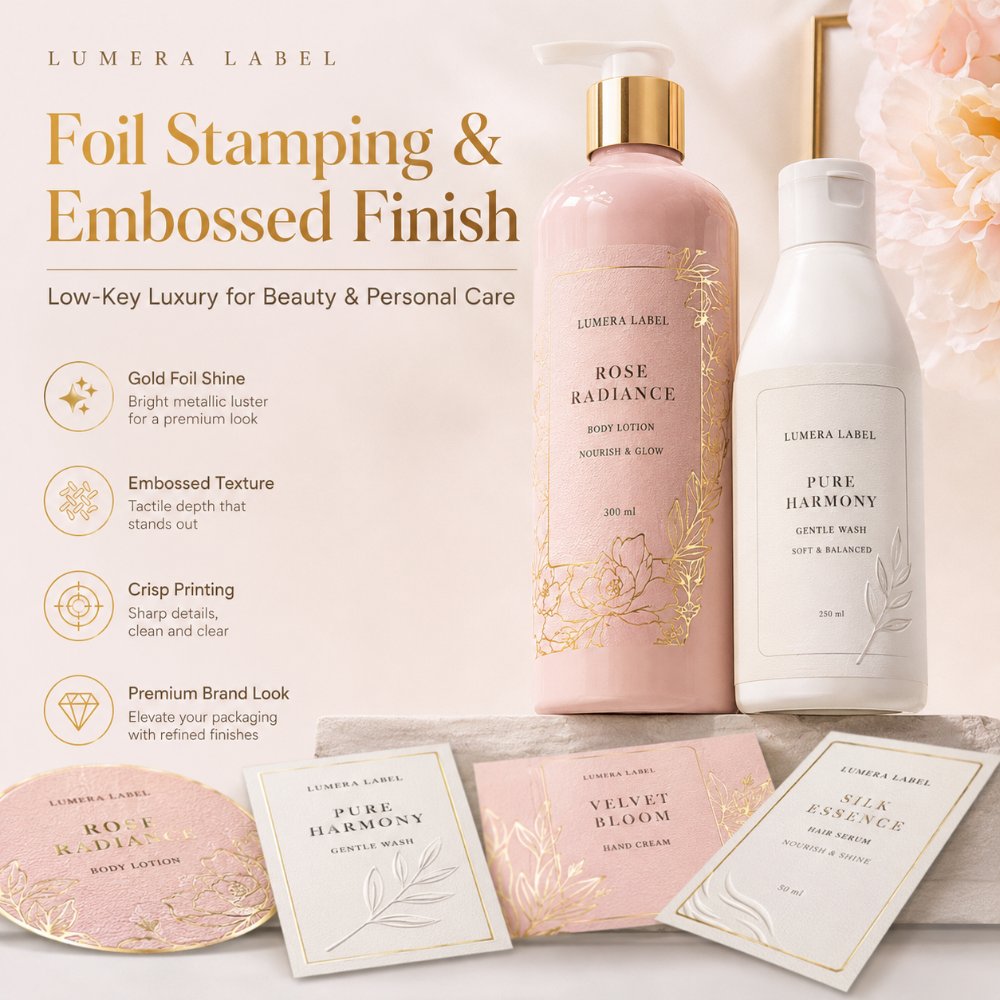
Official catalogue presentation of pink and white body-care containers with decorative label samples.
Give every supplier the same quotation schedule
Use the gold foil body-care cosmetic label reference to identify the catalogue item being discussed. Attach your actual requirement and ask the supplier to confirm what it is offering. A catalogue description does not establish the charge structure for your job. Keep bottles and finished cosmetics outside a label-only RFQ unless you separately request and receive confirmation of those items.
Assign an identifier and revision to each requested design. State the quantity for each version, the total order quantity, and which options are alternatives rather than additional purchases. If your comparison covers other items in the cosmetic-label catalogue, request separate quotation lines. Do not combine unrelated product references into one average price.
Separate conditional initial charges from recurring lines
Ask whether the supplier proposes any artwork preparation, origination, proof, sample or tooling charge. These are questions about the quotation, not statements that every job needs those services. For each proposed charge, request its trigger, counted unit and included work. Clarify whether it applies per order, per design, per revision or to another supplier-defined scope.
If a proof is offered, distinguish its preparation charge from any later revision charge. Ask what approval stage the price covers and whether another approval round would require a revised quotation. If tooling is proposed, request its reference and the label versions to which the charge applies. Do not infer a separate tool for every design, or assume a shared charge, without confirmation.
Then ask for the recurring label charge and any recurring order-level fee. A charge described as setup could still recur under the supplier’s stated conditions. Record the actual basis in the comparison sheet instead of moving every setup-labelled item into a one-time column automatically.
Official catalogue illustration of body-care bottles, label rolls and loose label samples.
Supplier response matrix
Buying field
Requested supplier response
Product and version reference
Confirm the offered label reference, each design identifier and its revision; identify any requirement excluded from the offer.
Requested quantity tiers
Quote the buyer’s requested quantity schedule and design allocation; identify alternatives separately and state any unavailable option.
Selling and counting unit
State the unit used for pricing and the finished-label quantity represented by that unit.
Setup or origination
If charged, itemize the trigger, scope and counted unit, and confirm whether it applies again to the stated repeat scenario.
Proofs and revisions
If offered, separate proof or sample charges from later revision charges; state what each quoted approval stage includes.
Proposed tooling
If applicable, identify the proposed tooling reference, related versions, charge basis and confirmed repeat-use conditions.
Recurring production and order fees
Separate the finished-label charge from any fee that recurs per order or another stated unit.
Included and excluded items
Identify selected extras, packing and dispatch charges as included, separately quoted, excluded or pending confirmation.
Unchanged-repeat scenario
Give its applicable total and conditions, or mark it unconfirmed; list changes that require a revised quotation.
Quotation basis
State currency, validity, delivery-cost basis and the quote revision against which the buyer should compare totals.
Check quantities, versions and the counted unit
Request quantity-tier quotations against your own purchasing schedule. State whether each tier represents an alternative order size, and show the allocation by design within that tier. A total quantity spread across several versions should not be compared with the same total for a single version unless the supplier has explicitly quoted both arrangements.
Confirm the selling unit before dividing a line total. It could be a supplier-defined pack or another quoted unit rather than one finished label. Request the number of finished labels represented by that unit and identify the price denominator. Keep quoted quantity, requested quantity and any stated delivery-quantity allowance in separate fields; do not invent an allowance where none is confirmed.
Use the request table below to make missing answers visible. A blank setup line should be clarified as included, separately chargeable, not applicable or not yet quoted. It should not silently become a zero-cost assumption.
Compare two totals with the same inclusions
Build the initial-order comparison from confirmed initial charges, recurring label charges and selected extras. Build the repeat-order comparison from the supplier’s stated repeat basis, adding any charge it says would apply again. Include an optional proof or other service only when it is part of the purchasing scenario you are comparing.
Check currency, quotation validity and the stated delivery-cost basis alongside the product lines. Ask which packing, dispatch or other charges are included and which remain outside the quotation. If one supplier has left a material item unquoted, mark that comparison incomplete. Do not create an estimated price merely to make the total column look finished.
You may calculate an effective quoted cost per finished label by dividing a confirmed scenario total by its confirmed finished-label quantity. Label the result as an initial-order or repeat-order comparison. It is your calculation for that stated scenario, not a new supplier unit-price promise.
Define the conditions for an unchanged reorder
Before relying on a repeat price, ask what the supplier considers unchanged. Refer to the earlier quote, approved version and product specification, and request a list of changes that would require a new assessment. A different design count, quantity allocation or approved specification may affect the quotation, but only the supplier can confirm its treatment for the actual offer.
If the supplier proposes retaining a production reference or tooling for repeat work, ask what reuse and retention arrangements apply. Do not assume that an initial payment guarantees future availability or eliminates every later charge. Record the confirmed reference, applicable conditions and any stated limit, then request a revised quote whenever the repeat request falls outside that scope.
Official catalogue illustration of body-care bottles and label media, used as a cosmetic-label product reference.
Send an RFQ that separates the purchasing decisions
The example below uses buyer-defined Version A and Version B to make the cost questions concrete. Replace those placeholders with your own design identifiers and quantities. Keep initial approval work, production quantity and the unchanged-repeat scenario distinct so the supplier can answer each commercial question without guessing what the comparison includes.
Include these references with the RFQ
The offered label reference and current specification.
The artwork version schedule and requested quantities.
The responsible artwork and commercial approvers.
Example request to the supplier
Subject: Initial and unchanged-repeat quotation for body-care foil labelsPlease quote labels only against the linked body-care label reference and our attached requirement. Our schedule identifies Version A for body wash and Version B for lotion, with a separate design revision and requested quantity for each. The quantity tiers in the attachment are alternative order scenarios, not additional orders. Please confirm the actual offered specification and flag requirements you cannot quote.For each scenario, separate any proposed setup, artwork preparation, proof, sample or tooling charge from recurring label and order-level charges. State the unit and version scope of each line. Identify what is included, separately quoted, excluded or still pending, and provide the initial-order total on your stated currency and delivery-cost basis.Please also quote an unchanged repeat using the same approved versions and quantities, or explain what information is needed before that total can be confirmed. State which charges would apply again, any proposed reuse conditions, and changes that would trigger a revised quote. Please return the completed cost table with your quotation identifier, revision and validity.
Buyer FAQ
Is setup always a one-time cost?
No such assumption should be made from the wording alone. Ask what triggers the charge and whether it applies per design, order, revision or another scope. Use it as a non-recurring cost only for the repeat conditions the supplier actually confirms.
Should I compare only the price per label?
Compare the complete quoted scenario as well. Initial charges and selected extras can change the total even when label unit prices look similar. Confirm the counting unit and included work before calculating an effective cost per finished label.
Can several designs share one setup charge?
Ask the supplier to quote the actual version schedule both clearly and completely. It may quote separate lines or a confirmed combined line, but neither arrangement should be assumed. Request an explanation of which versions and revisions each charge covers.
What should be checked before using a reorder price?
Check the prior quote reference, approved version, requested quantities and applicable specification. Ask whether the new request meets the supplier’s unchanged-repeat conditions. If it does not, obtain a revised quotation rather than carrying the earlier total forward.
How should proof and sample costs appear?
Request separate applicability and scope for each offered item. Ask whether any charge is credited against a later order only if such an arrangement is proposed. Record the supplier’s answer; do not assume free proofs, unlimited revisions or automatic credits.
wholesale cosmetic labelsB2B supplier sample record