
Foil Label RFQs: Mark the Finish Artwork Layers
For a foil-label RFQ, ask the supplier to mark the actual offered finish areas separately from ordinary printed content. Identify the proposed foil region, any embossed region if offered, and the reference file or drawing that defines each. Connect those references to the same label version and sample before accepting a finish description in the quotation.
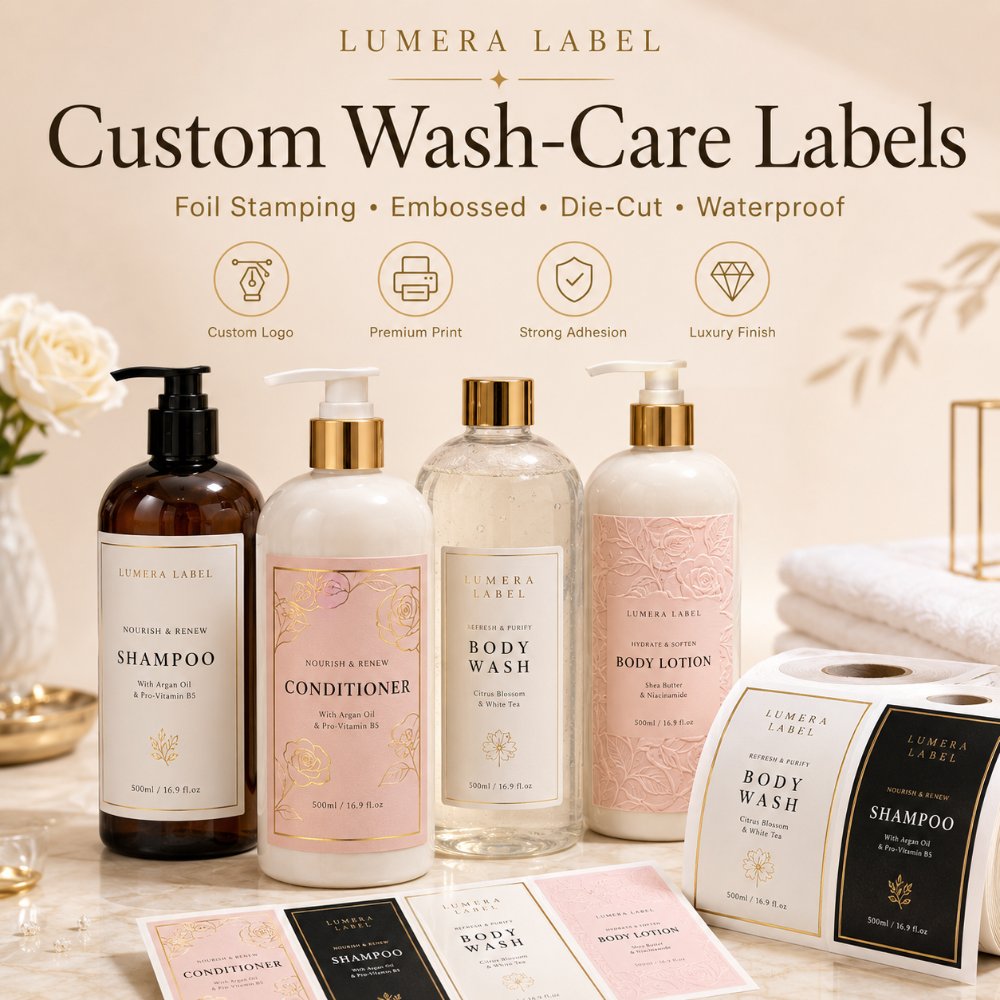
When sourcing wholesale cosmetic labels, a catalogue presentation may show metallic-looking lines, textured-looking decoration and printed text together. A combined image does not explain which parts belong to each proposed process. A finish-layer schedule makes the supplier discussion specific, helping the buyer compare the requested appearance with the actual finish scope being offered.
Official supplier catalogue illustration for label-finish discussion. Displayed bottles, sample branding and advertising copy do not establish included packaging, brand authorization or verified product performance.
Start with the actual body-care label offer
The official Custom Gold Foil Stamping Self-Adhesive Labels for Wash & Body Care Cosmetics listing provides the product-family reference. Its catalogue scenes present labels on bottles, rolls and loose samples. Use those scenes to identify the appearance being discussed, then ask the supplier to connect the quotation to an exact label design and proposed finish version.
The bottles and sample names in the catalogue are presentation references for the labels. They do not define the contents of a packaging supply order or establish a relationship with a displayed sample brand. Keep the inquiry focused on the actual label offer: its supplier design identifier, the buyer reference being considered and the sample or artwork version used in the supplier reply.
Separate the proposed foil area from printed content
Ask the supplier to identify which parts of the offered design it proposes to produce with foil and which parts remain ordinary printed content. Request a marked artwork view or another separation reference that makes the boundaries clear. A gold-coloured line in a catalogue image is an appearance cue, not sufficient evidence of the production method used for a particular order.
Give each proposed region an identifiable name in the discussion. The supplier response should make it possible to connect a visual area to its stated finish scope without relying on a general description such as premium gold decoration. If the buyer request and supplier proposal differ, keep both references visible until the accepted finish allocation has been agreed.
Buying field
Requested supplier response
Label identity
Supplier design reference and the exact offered artwork version.
Foil region
Marked area proposed for foil, with an identified separation reference.
Embossed region
Separate area and reference if embossing is actually offered.
Printed content
Text, graphics and other content excluded from the proposed finish areas.
File relationship
Supplier explanation of how the separation references relate to the complete design.
Sample and revision
Identified sample or proof and the accepted finish-scope revision.
Official supplier catalogue illustration for label-finish discussion. Displayed bottles, sample branding and advertising copy do not establish included packaging, brand authorization or verified product performance.
Identify embossing separately if it is offered
If the supplier includes embossing in the offer, ask it to mark the relevant area independently of the foil reference. Clarify whether the proposed embossed region overlaps a foil region, is positioned elsewhere or is omitted from the selected version. Those alternatives need a supplier answer; a raised-looking feature in a styled image does not settle the offered construction.
Ask which file or document the supplier uses to identify that proposed embossed area and how it relates to the full artwork. Retain the names or codes of the references it provides. The buyer does not need to prescribe an unconfirmed production setup, tooling specification or file format. The immediate purpose is to obtain a clear mapping that the supplier can explain for its actual proposal.
Keep the full artwork and separation references aligned
Request the complete artwork reference alongside the marked finish areas. Both should identify the same design revision. Ask the supplier to explain any difference between the visual proof and the separation documents before treating them as an agreed set. This is especially useful when a design contains fine lines, lettering and a background graphic that are easy to describe differently in separate messages.
When a requested design change affects a finish region, ask for the corresponding updated reference rather than retaining an unexplained mix of old and new files. Keep unchanged areas identifiable as well. A purchasing record should show which complete design and finish allocation belong together, so that an earlier proof is not accidentally used to answer a question about the revised offer.
Official supplier catalogue illustration for label-finish discussion. Displayed bottles, sample branding and advertising copy do not establish included packaging, brand authorization or verified product performance.
Match the sample and quotation to the agreed finish scope
Ask the supplier for an identified sample or proof corresponding to its proposed label version. Connect that reference to the marked foil area, any offered embossing and the remaining printed content. Describe a visual difference against the specific region being discussed. The buyer can then ask a focused question about the proposal rather than requesting a general match to a catalogue scene.
Before accepting the quotation, check that the label design, finish allocation and sample reference describe the same offered version. Ask the supplier to identify any alternative or limitation separately. Retain the accepted revision for a repeat order and request an updated reference when the offer changes. Approval of a finish map does not establish adhesion, water resistance, durability or other performance; those subjects require their own applicable supplier information.
Buyer FAQ
Does a gold-coloured catalogue detail prove that foil is offered?
Ask the supplier to identify the actual proposed process and mark the area it covers for the selected label version.
Should foil and embossing use one undefined artwork reference?
Request clear references for each offered finish area and ask how they relate to the complete design. Keep the scopes distinguishable even where they overlap.
What should happen when the label artwork changes?
Request the updated complete design and affected finish references together, retaining a clear revision relationship to the sample or proof.
Do the catalogue bottles define what the supplier will deliver?
They illustrate label presentations. Obtain the actual supply scope from the supplier quotation rather than assuming that bottles or every displayed design are included.
Begin with the official body-care foil-label reference, review the label catalogue and request the actual offered finish-layer references through the supplier website.
Identify the actual label artwork and offered finish version.
Distinguish proposed foil, embossing if offered and ordinary printed content.
Retain the aligned references, sample and accepted revision with the quotation.
wholesale cosmetic labelsB2B supplier sample record