
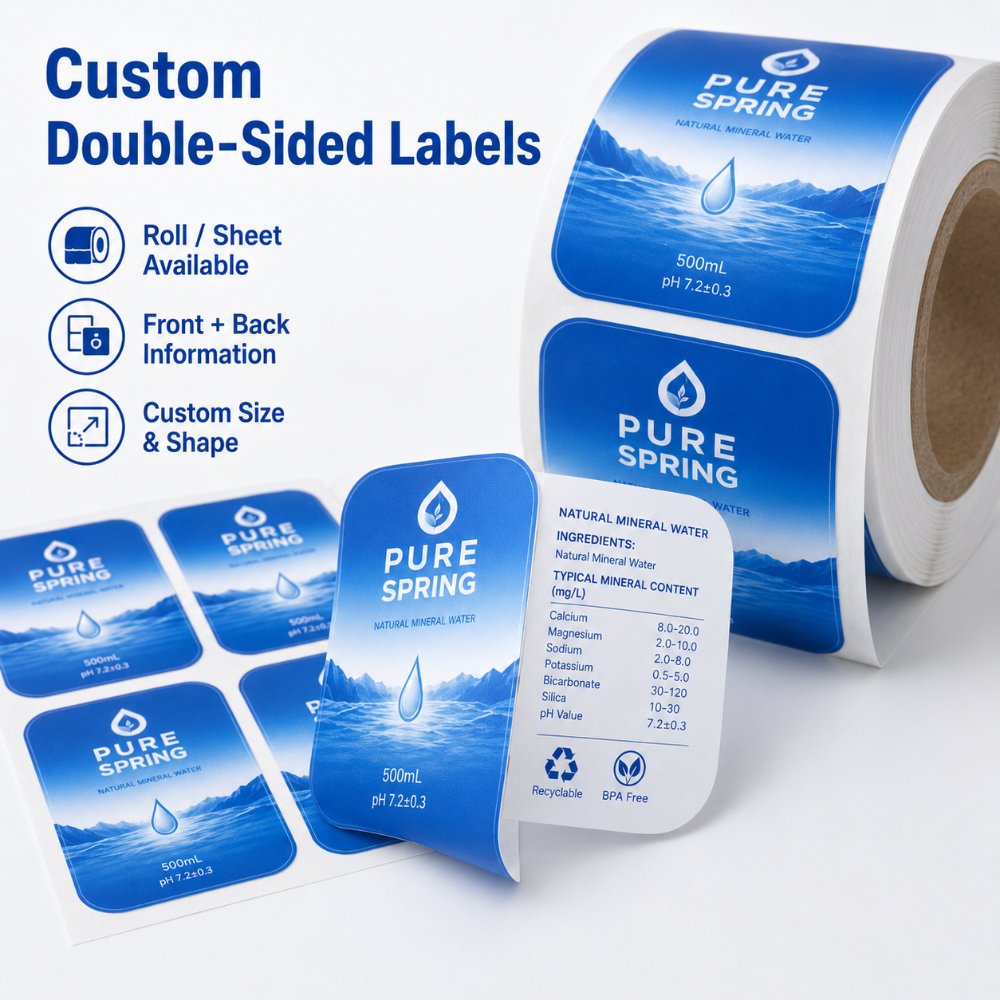
Choose roll or sheet supply for beverage bottle labels by describing how the labels will reach the bottle. Identify the application process, request the supplier’s proposed delivery arrangement, and compare quotations using the same artwork, requested quantity and supply unit. Approve the format for the actual job rather than selecting it from a catalogue photograph alone.
Begin with the actual application process
Our custom beverage bottle label listing describes roll and sheet options, front-and-back full-colour printing, and enquiries for custom size, contour and graphics. These options provide a starting point for a format discussion. The next step is to describe the order-specific arrangement that the supplier needs to quote and prepare.
Tell the supplier whether people will apply labels at a workbench, whether particular equipment is involved, or whether an initial sample is needed for an application trial. Name the intended process and provide relevant equipment requirements where applicable. A roll illustration does not establish compatibility with a particular machine, and a sheet illustration does not describe every handling detail required by a buyer.
Also explain how the labels will be distributed after delivery. A single workshop and several separate packing locations can need different delivery identification. Let the supplier propose an arrangement against those facts. When the process is undecided, ask for two clearly described alternatives rather than accepting an unexplained format name.
Compare equivalent quotation briefs
Keep the product definition constant when requesting roll and sheet quotations. Supply the same bottle reference, finished-label outline, artwork reference and requested quantity. Ask the supplier to identify the differences between its proposed delivery arrangements. This supports a useful comparison without assuming that one format is always cheaper or better for every buyer.
Decision point | Roll enquiry | Sheet enquiry
Arrangement | Request an identified roll-format drawing | Request an identified sheet-layout drawing
Application | Provide handling or equipment requirements | Describe handling and access to individual labels
Quantity | Define finished labels and proposed rolls | Define finished labels and proposed sheets
Identification | Agree the order and artwork reference on each roll | Agree references on each sheet pack
Trial | Identify the sample and proposed trial scope | Identify the sample and proposed trial scope
Where equipment is involved, send its relevant requirements to the supplier instead of inventing a universal roll specification. Ask which dimensions, orientation information and delivery details need confirmation for that equipment. Record the supplier’s answer for the offered job. Technical values should come from the agreed specification or drawing rather than assumptions based on a product image.
Define the quotation and delivery units
One quotation may describe labels while another describes rolls or sheets. Ask the supplier to state the priced unit and the proposed contents of each delivery unit. Keep the requested total of finished labels visible. Request clarification of any separate preparation, packing or other charges rather than filling gaps with assumed quantities or costs.
Split different artwork versions into named order lines. A project total should not hide how the requested quantity is allocated among designs. Connect each line to its own artwork reference and proposed supply format, then ask whether the supplier has quoted those lines separately. Record the actual commercial conditions offered for the requested combination.
For front and information-side artwork, describe the delivery relationship that needs a supplier answer. Ask whether the offered format uses separate identified delivery lines or another specified arrangement. The artwork decision and delivery-format decision should refer to the same job, with a clear scope for each approval.
Use a drawing and an identified trial sample
A format drawing helps the buyer and supplier discuss the proposed arrangement before a physical sample is available. Ask the supplier to identify the drawing revision and any missing information needed to finish it. Keep unresolved requirements visible so an initial discussion cannot be mistaken for a final production release.
• Link the format drawing with the artwork and finished-label outline.
• Confirm the intended application process and delivery unit.
• Identify the supplied sample and the arrangement it represents.
• Keep trial observations with the supplier reference and buyer decision.
If a sample is supplied, evaluate it under the process agreed for the trial. Document what was observed and what remains open. An observation on one identified sample is a specific result. Wider order acceptance conditions should be agreed separately in writing. The catalogue’s promotional descriptions should not replace a job-specific application assessment.
Make the decision usable for replenishment
Save the accepted format drawing with the quotation, artwork reference and sample decision. At reorder, state whether the same arrangement is requested and identify changes to the quantity, artwork or application process. This gives the supplier a clear basis for retaining the previous arrangement or preparing a revised proposal.
Ask for the supplier’s handling and storage guidance for the offered labels. Pass that guidance and delivery identification to the receiving team. Send the bottle reference and planned application process through our contact page. The label sourcing blog covers related purchasing topics.
Frequently asked questions
Is roll supply always better for bulk labels?
Compare the actual proposals against the intended application process, quantity and delivery needs. A catalogue format name alone does not establish the best choice for a particular order.
What should a roll-versus-sheet enquiry include?
Include the bottle, artwork and outline references, requested quantity, planned application method and delivery information that needs supplier confirmation.
Can a sheet count be compared directly with a label count?
First confirm how many finished labels the proposed sheet contains and what unit the supplier has priced. Keep the delivery-unit description and finished-label quantity visible.
Does a roll photograph prove machine compatibility?
Request a confirmation for the proposed arrangement using the buyer’s actual equipment requirements. Evaluate an identified sample under an agreed trial scope where appropriate.
Product and contact references
https://yylabels.com/product/custom-double-sided-printing-self-adhesive-labels-for-mineral-water-drinking-beverage-plastic-bottle-packaging/
https://yylabels.com/contact/
https://yylabels.com/blog/