
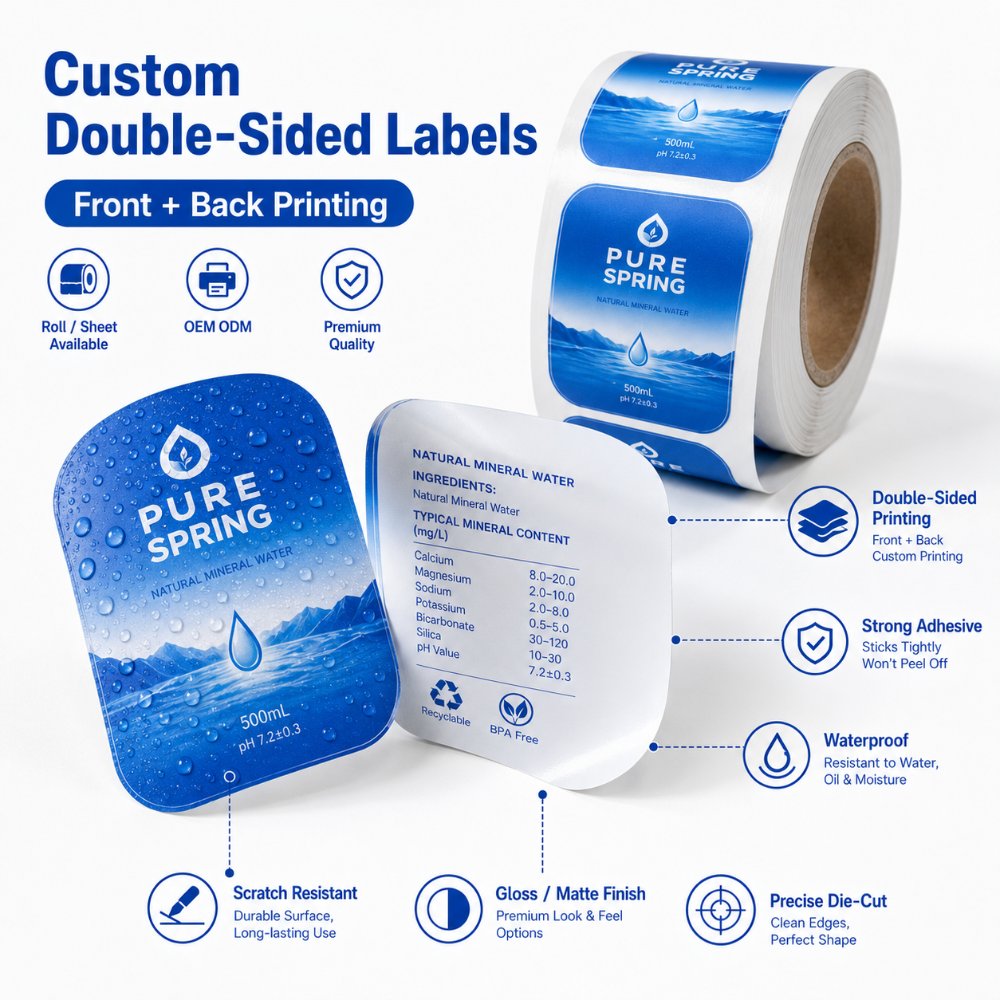
For a custom beverage bottle label, approve an identified finished outline against an identified container reference. Show which line represents the label edge, explain the direction of each dimension and connect the drawing to the supplier’s current proof. This creates a clear shape enquiry without asking a catalogue photograph to serve as a measured production drawing.
Turn a shape description into a specific drawing
Our custom beverage bottle label listing accepts enquiries for custom size, contour and graphics. Buyers can use that offer to begin a label shape discussion, then provide the container and drawing details needed for the particular job. A request for a rounded or custom-shaped label is a starting description; the supplier still needs to know exactly which outline the buyer wants quoted.
Give the proposed shape a reference name or number. Place that reference on the enquiry, drawing and subsequent proof so the team can distinguish it from other bottle sizes or design concepts. If the buyer is comparing alternative contours, give each alternative its own reference. Keep the options separate until a chosen outline has been confirmed for the quotation.
A simple outline drawing is often easier to discuss than a busy marketing image. Provide a clear view of the proposed label boundary and state which container it is intended to accompany. Ask the supplier to identify any information it needs to prepare a job-specific drawing. This keeps the conversation focused on an offered shape rather than on an assumed interpretation of the photograph.
Distinguish the finished edge from the printed design
The visible edge of a coloured graphic does not necessarily identify the intended finished edge of a label. A design may include a background, a border or white space around the main artwork. Mark the proposed finished outline explicitly and ask the supplier to show how it relates to the graphic in the current proof.
Where several lines appear in a file, include a short legend. State which line is the buyer’s proposed finished boundary and ask the supplier to explain the role of any preparation lines it adds. Request its requirements for this particular job rather than inserting an assumed cutting allowance, bleed value or tolerance. Agreed technical values should appear in the written drawing or quotation.
Reference item | What the buyer supplies | What to confirm with the supplier
Finished outline | A clearly marked proposed label boundary | The line covered by the quoted shape
Artwork position | The design shown relative to that boundary | Any proposed preparation changes
Dimensions | Named directions, units and reference points | Which dimensions the drawing defines
Container reference | An identified bottle drawing, photograph or sample | The container and placement considered for the job
Drawing revision | The current file and a list of requested changes | The proof revision awaiting approval
Name the dimension direction and its endpoints
A size written as two numbers can leave room for interpretation. Put the units on the drawing, identify the orientation and show where each dimension begins and ends. If the outline has an irregular top, curved side or projecting detail, indicate which points are used for the stated overall dimension. The purpose is to let the buyer and supplier discuss the same distance.
Keep the drawing’s viewing direction clear. A label displayed beside a bottle, a label shown flat and a label pictured on a curved surface can present the same design differently. Use a flat drawing for the proposed outline and connect it to an annotated container view for placement. Do not derive a finished width or height by measuring pixels in a catalogue image.
If a buyer sends dimensions from an existing label sample, record which sample was measured and how it was positioned. Ask the supplier to identify any difference between that sample reference and the proposed drawing. Leave unresolved points visible in the enquiry instead of converting a rough measurement into an accepted production value without discussion.
Keep the container reference attached to the shape enquiry
Name the bottle version intended for the order. An updated container, a different capacity or a changed presentation may need a separate review even when the artwork looks familiar. Send the supplier the relevant bottle reference and mark the proposed label location. Ask it to confirm what container information it has used when preparing its drawing.
Where a physical sample or application review is requested, agree what will be examined and how the result will be recorded. The outline drawing, material enquiry and application assessment are connected purchasing tasks, each with its own decision. A matched drawing reference helps keep those decisions traceable without claiming that the catalogue scene has already demonstrated the finished result.
Release the outline revision that was actually reviewed
When the contour changes, identify the changed drawing and request an updated proof. A clear change note can state which edge, corner or dimension has been revised and whether the artwork position also needs adjustment. The supplier’s response should refer to the current drawing rather than to an older attachment that happens to carry the same product name.
Record the approver, decision date and any open conditions with the final outline reference. If artwork is reviewed separately, connect its approval to the same job; our guide to approving a double-sided artwork pair covers that related step. For a new shape enquiry, send the proposed drawing and bottle reference through our contact page.
Send a concise outline enquiry
• Attach the proposed outline file and identify its current revision.
• Name the intended container and mark the proposed label location.
• State units and dimensional directions, then list any open drawing questions.
Frequently asked questions
Can a bottle photograph define the label outline?
A photograph helps explain the intended presentation. Use an identified drawing with units and marked boundaries to define the proposed finished outline for a quotation.
Should the finished boundary be shown separately from graphics?
Yes. Identify the line representing the proposed finished edge and show the artwork relative to it. Ask the supplier to explain any additional preparation lines in its proof.
What should be included with a custom contour enquiry?
Include the outline reference, relevant dimensions and directions, intended bottle reference, artwork context and the decision or question the supplier needs to address.
Does a revised shape need a revised proof reference?
Request a proof that identifies the current drawing revision and records the requested change. Keep earlier versions for traceability while clearly naming the version being considered for release.
Product and contact references
https://yylabels.com/product/custom-double-sided-printing-self-adhesive-labels-for-mineral-water-drinking-beverage-plastic-bottle-packaging/
https://yylabels.com/double-sided-labels-approve-the-artwork-pair/
https://yylabels.com/contact/