
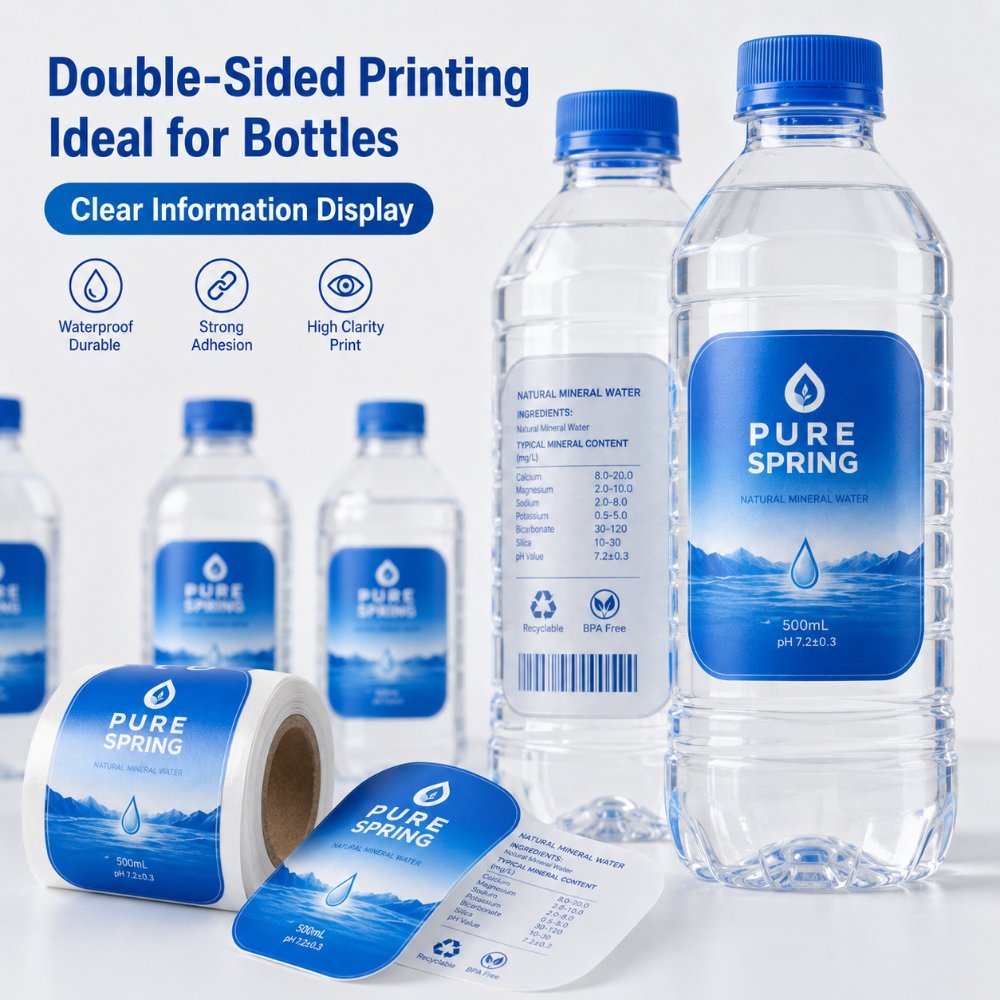
For custom double-sided beverage labels, approve the front and back as one identified artwork pair. Give each side a file reference, name the intended viewing direction, connect both files to the same bottle presentation and release a single matched revision. This gives the buyer, designer and label supplier one clear answer to the question: which two designs belong together for this order?
Start with the label offer and the bottle presentation
Our custom double-sided beverage label listing describes front-and-back full-colour printing, roll or sheet formats, and enquiries for custom size, contour, graphics, ingredient text and barcodes. These options are a useful starting point for an artwork discussion. The first approval task is to turn that broad description into a drawing set for the particular beverage and container.
Ask the supplier to explain how the proposed construction presents the two designs. A phrase such as front and back can refer to artwork roles, physical placement or a viewing arrangement. Use a marked drawing to make the intended result clear. Label the consumer-facing display and the information-facing display, and show how each should appear when the bottle is held in the agreed orientation.
Keep the bottle reference in the same record. A photograph, drawing or identified container sample can provide that reference. Record which container the artwork has been prepared for, then ask the supplier to confirm any information still needed to prepare its print proof. A catalogue bottle photograph should not silently become the dimensional drawing for a different container.
Give the two files a shared approval identity
A buyer may receive the front design in one email and the information panel in another. Both can look current while belonging to different revisions. A paired approval sheet makes the relationship visible before a purchase order is released. Use a buyer-defined pair identifier and include both filenames, revision dates and the person responsible for the final decision.
Approval field | What to record | Buyer decision
Artwork pair | Shared order or project reference | Both sides belong to this release
Front file | Exact filename and revision | Display artwork accepted or changes marked
Information file | Exact filename and revision | Text and code content accepted or changes marked
Viewing reference | Annotated bottle layout and orientation | Placement relationship understood
Proof reference | Supplier proof identifier and date | Reviewed proof matches the named pair
Release state | Approver, date and remaining conditions | Approved, revise or awaiting information
The identifier can be simple; its purpose is traceability. When one file changes, update the paired record and explicitly state whether the other file remains unchanged. Avoid using a convenient old front proof as an attachment to a new back proof without recording their relationship. The supplier should be able to locate the exact files covered by the buyer’s latest approval.
Separate artwork content from print preparation
The buyer should nominate the source of the brand artwork, product name, ingredients and barcode data supplied for the job. Ask the supplier to identify any changes made while preparing its proof. A change log is especially helpful where a text block has been reformatted to fit the available space or a graphic has been repositioned near the contour.
Review the design content and the production drawing as connected records. The drawing can identify the proposed finished outline, artwork positions and any preparation areas requested by the supplier. Request the supplier’s file requirements for this job rather than assuming a universal file format, bleed allowance or printing tolerance. Agreed technical values belong in the written quotation or approved drawing.
• Check the exact spelling and version of the product name on both artwork files.
• Compare the information text with the buyer’s approved source document.
• Identify the barcode data supplied and agree how its printed result will be assessed.
• Mark the intended orientation and relative placement of the two designs.
• List open questions separately so a conditional approval cannot be mistaken for a production release.
Artwork approval confirms the recorded design decision. Material selection, adhesive behaviour and any required documentation still need their own agreed scope. Keep these purchasing questions linked to the order without treating a visually attractive proof as evidence of every physical property of the finished label.
Connect the approved pair to roll or sheet delivery
The listing presents roll and sheet options. Tell the supplier which presentation is required for the order and ask how the approved artwork pair will be arranged in that format. Where two artwork roles are supplied separately, identify each delivery line. Where a combined arrangement is proposed, request a drawing showing the relationship clearly.
The artwork record should travel with the commercial enquiry. State the requested quantities by the agreed supply unit and separate any variants into named lines. Ask the supplier to confirm the arrangement it has quoted. A roll illustration helps begin that conversation, but the actual order needs a written format description tied to the approved files.
Keep a usable record for revisions and reorders
Save the final pair record with the supplier proof and the buyer’s release decision. For a reorder, compare the new request with that record before reusing the old artwork. A changed ingredient statement, barcode, bottle reference or artwork language may require a revised pair even when the front image appears familiar.
A concise change note is more useful than a long email history. Name the previous pair, state the requested change and identify the new proof that resolves it. Send the complete enquiry through our contact page with both artwork files and the bottle reference. For other packaging topics, browse the label sourcing blog.
Frequently asked questions
Should front and back artwork have separate filenames?
Separate filenames are helpful, provided the approval record identifies which files form the matched pair. Record exact revisions and connect both to one release decision.
Does a double-sided label description define the construction?
Ask the supplier to show the proposed construction and viewing arrangement for the offered job. Use an annotated drawing to connect the description with the intended bottle presentation.
Can the catalogue artwork be used as the final order proof?
Use catalogue designs to discuss the required layout. Request a job-specific proof carrying the buyer’s actual artwork, information text and agreed bottle reference before release.
What should be checked when only one side changes?
Identify the revised file, retain the unchanged file reference and issue an updated pair record. Confirm that the supplier’s latest proof contains the intended combination.
Product and contact references
https://yylabels.com/product/custom-double-sided-printing-self-adhesive-labels-for-mineral-water-drinking-beverage-plastic-bottle-packaging/
https://yylabels.com/contact/
https://yylabels.com/blog/